


Nilava Sen
Bharatanatyam Artiste
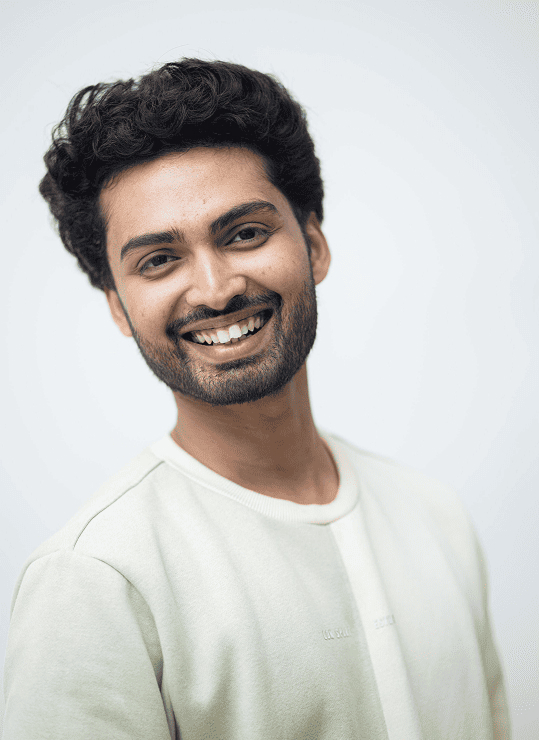
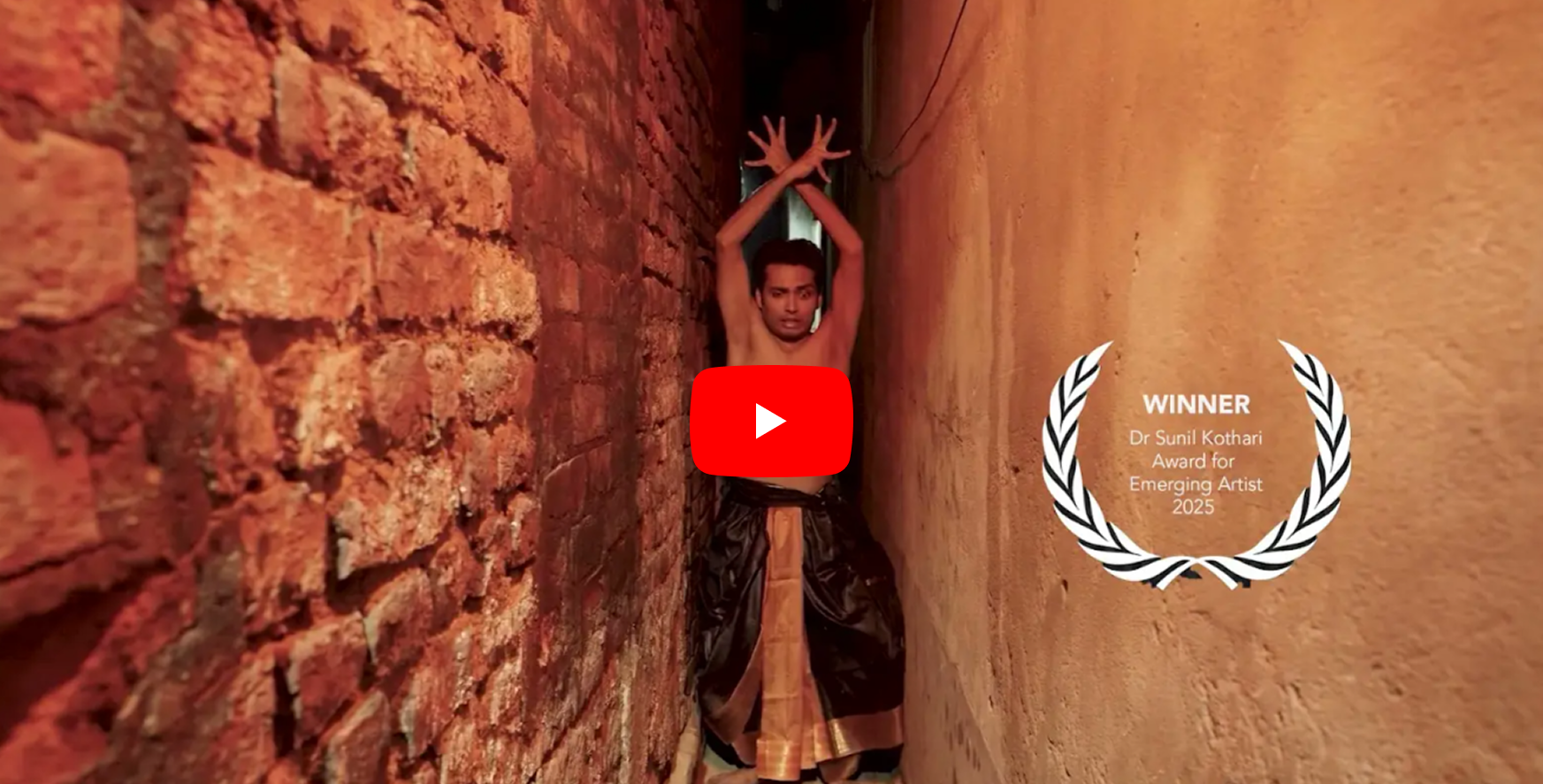
In January 2026, Bharatanatyam artist Nilava Sen won the Sunil Kothari Emerging Artist Award 2025 instituted by the Aditi Mangaldas Dance Company and The Drishtikon Dance Foundation. The award was a recognition for his dance film The Traffic, a work that is a deeply introspective and personal exploration in which Nilava lends an artistic voice to his own dilemmas as a performer.
How did the idea for The Traffic first emerge? What experiences or questions led you toward this concept?
The idea of The Traffic actually emerged much later in the process of engaging with this work. The core of the work initially, was something more personal. I approached it as a form of dance practice — dance as a way to express my inner world, or eventually as a kind of prayer to the divine. Every element of the film is rooted in real experiences from my own life. I reached a point where I felt it was necessary to release those emotions from my body and give them a definite form.
Rather than holding me back, those emotions pushed me to write this piece. They helped me understand what “traffic” truly represents in life — not just external chaos, but the inner collisions we experience as human beings.
The film is shaped by questions I was asking myself at that time: What truly traffics are in my life? Is experiencing congestion, confusion, or emotional overwhelm something inherently wrong? And how do I give language — both physical and emotional — to my wounds?
We are often conditioned to pursue happiness and peace, but we are rarely taught how to navigate the moments when life becomes heavy or chaotic. Fear, in particular, is frequently labeled as weakness, even though it is one of the most honest and universal human emotions. Through this work, I wanted to explore how fear can be acknowledged, communicated, and ultimately transformed — how our perceived weaknesses can become sources of strength.
Creating The Traffic was my way of confronting these questions and translating them into art. It is not about offering answers, but about allowing space for expression — using movement and film as a means to face what we carry inside and share it truthfully with the world.
Concept: Rama Vaidyanathan
Music Composition & Production: Debapriya Adhikary
Assisted by: Raj Narayan
Music Edit, Mixing & Master: Bhavesh Modak
Vocals: Debapriya Adhikary, Raj Narayan, Arghya Chakraborty
Pakhawaj: Joy Nandy
Studio: On Air, Kolkata
Film Producers: Nilava Sen, Lubdhak Chatterjee
Film Production: Vichitrashala
Cinematography, Edit & Film Direction: Lubdhak Chatterjee
Assistant Cinematography: Ashok Bej
Sound Design & Mixing: Saugata Banerjee
Assistant Director: Suva Maity
Boat Man: Arun Majhi
Line Producer: Saugata Banerjee
Script, Choreography & Dance: Nilava Sen
Special Thanks
Nirmal Sen, Jolly Sen, Shyam Mohan, Deboprasad, Prithvi Mahato, Prasenjit Chandra, Souradeep Datta, Gaurab Das, Anuchintan Art Centre
What has it been like to receive recognition for The Traffic?
Receiving the Dr Sunil Kothari Award for this film is truly an honour, and I’m deeply grateful for the recognition. That said, my primary intention was never driven by that. I simply wanted to create something that was honest, personal, and rooted in lived experience, and to share that truth openly through my work.
Your training spans Uday Shankar–style movement, Bharatanatyam, and contemporary dance. How have these diverse practices informed the inner conflicts and dilemmas explored in The Traffic?
Yes, I have been formally trained in both the Uday Shankar technique and Bharatanatyam, which are fundamentally different artistic disciplines. The Uday Shankar technique emphasizes fluidity, freedom, and an embodied sense of movement — allowing the body to flow without rigid constraints. Bharatanatyam, on the other hand, has taught me structure, precision, and depth, encouraging a more grounded and detailed engagement with movement.
Initially, training in these two contrasting forms created a sense of conflict within my body. Over time, however, I came to accept — and embrace — the fact that I am deeply connected to both. Once I made peace with that duality, the apparent chaos transformed into balance.
Today, these two forms flow through me equally, complementing one another much like the Ida and Pingala. When I dance, they coexist in harmony, and it is within that balance of freedom and structure that I truly find my sense of artistic and personal freedom.
Dance on film is relatively an unfamiliar ground, especially for classical dancers.
How do you think young dancers can begin engaging with this medium, and what sparked your own interest in exploring dance for the camera?
I’ve always been deeply interested in observing what’s happening both around me and within me. When I began working on this film, my intention was to keep it as real and unfiltered as possible — true to who I am and how I perceive the world. That approach played a crucial role in helping me understand how to express myself through the camera.
For me, the camera functions much like the human eye. At times, it observes from a wider perspective; at other moments, it moves closer to capture subtle details and nuanced emotions. There are also instances where the gaze softens or blurs, allowing space for a more intuitive way of seeing. I consciously considered these shifts while writing the script, so the visual language would mirror my own process of observation.
My hope was that the audience would experience the film in the same way I experienced and observed it — through an honest, evolving perspective that invites them into my way of seeing.
How did your personal relationship with technique, discipline, and correction influence the creation of this piece?
It influenced me deeply. I’ve always had a strong tendency to chase perfection — whether in my dance practice or in my personal life. I constantly find myself correcting, refining, and pushing for things to be exactly right. At times, that pursuit can be motivating and fulfilling, but it can also become restrictive and emotionally suffocating.
Through this process, I’ve begun to understand the importance of balancing perfection with imperfection. I’m learning to make space for what is unfinished, flawed, or uncertain, and to embrace those aspects as an essential part of being human.
Ultimately, life itself isn’t perfect, and this realization has allowed me to approach both my art and my life with greater compassion and freedom.
You’ve spoken about technique as both an empowering tool and a form of constraint. How do you navigate this tension in your everyday practice?
For me, it’s always about finding a balance — between control and release, discipline and freedom. While I practice, I’m constantly aware of how much to hold, how much to let go, when to stay within boundaries, and when to step beyond them.
I strongly believe that in order to break boundaries with integrity, one must first understand them deeply. That’s why I begin by practicing the teachings as they are, with full respect for their structure and intent. Only when something feels truthful from within do I allow myself to push or reshape those boundaries.
This balance between discipline and intuition is what defines my everyday practice. It allows me to evolve honestly, without losing connection to the foundations that shape my work.
In The Traffic, is the idea of congestion something that ever truly resolves, or is the journey really about learning how to move within it?
With my current understanding — and acknowledging that this may evolve over time — I believe that “traffic” is an inevitable part of life. You may move past one challenge only to encounter another later. Real life is not a romanticized narrative; moments of congestion, uncertainty, and struggle are always present.
What I’m learning, and continue to learn, is how to find peace within that traffic rather than waiting for it to disappear. Both traffic and peace are essential. Without obstacles or pauses, the journey itself may not lead us where we need to go.
For me, the journey is about understanding how to move forward while still within the traffic — how to navigate it with awareness, patience, and acceptance. That process of learning is ongoing, and it has become central to both my life and my work.
Has creating The Traffic altered your relationship with perfection beyond the stage or studio?
Absolutely. The Traffic taught me how to speak honestly — whether the truth appears perfect or imperfect. I’m no longer interested in decorating reality. Instead, I want to articulate what already exists but is often ignored, and to express it exactly as it is.
In many ways, The Traffic marked the beginning of a deeper sense of purpose in my artistic journey. Moving forward, I want my work to speak for me — to acknowledge and address what remains unseen or unspoken, and to present it with sincerity and clarity.
I also strive to carry this approach into my life, practicing the same honesty and awareness beyond my art.